
Construction Project Manager: Career and Hiring Guide
A construction project manager (CPM) is the person accountable for a building project’s budget, schedule, contracts, and owner communication from groundbreaking to closeout. The U.S. Bureau of Labor Statistics reports a median annual wage of $106,980 as of May 2024, with employment growth projected to be faster than average from 2024 to 2034. The Occupational Information Network (O*NET) defines the role’s core tasks as planning, scheduling, budgeting, coordinating, and supervising construction activities. The Project Management Institute (PMI) PMP credential and the Construction Management Association of America (CMAA) Certified Construction Manager (CCM) are the two credentials employers most frequently request.
This guide serves two audiences:
Career seekers deciding whether to pursue the CPM role and what qualifications to build
Hiring managers who need a job description template, interview checklist, and vetting framework
Mid-career professionals with field or engineering backgrounds evaluating a transition into project management
Key Takeaways
A construction project manager is the accountable business lead on a project, responsible for budget, schedule, contracts, and owner communication, and the national median wage of $106,980 reflects strong, sustained employer demand for credentialed professionals.
Point | Details |
|---|---|
Median pay and growth | BLS reports $106,980 median annual wage (May 2024) with roughly 9% projected employment growth from 2024 to 2034. |
Top certifications | CCM (CMAA) is the most construction-specific credential; PMP (PMI) and OSHA 30 are broadly required by employers. |
Salary drivers | Project size, sector (data centers, biotech), CCM/PMP credential, and local market tightness push pay above the national median. |
Hiring must-haves | Require a redacted pay application, CPM schedule sample, and superintendent reference before making an offer. |
Burnout risk | Organizational justice (fair processes and respectful treatment) is the strongest buffer against CPM burnout per peer-reviewed research. |
Specialist recruiting | NetworkHUB offers pre-vetted CPM candidates, a prorated 90-day fee model, and lower commission rates for AEC employers. |
Table of Contents
Where do construction project managers work, and what are the hours?
What do construction project managers earn, and what is the job outlook?
What does career progression look like for a construction project manager?
How should employers write a construction project manager job description?
Why is construction project management one of the most stressful roles in the industry?
How specialist recruiters source and vet construction project managers
Hire vetted construction project managers faster with R. Construction Solutions
What does a construction project manager do every day?
The CPM role sits at the intersection of business administration and field execution. On any given day, the manager is simultaneously tracking cost against budget, enforcing the project schedule, processing contract documents, and keeping the owner informed. The project management lifecycle spans preconstruction through closeout, and the PM’s responsibilities shift at each phase.
Core duties include:
Developing and maintaining the project schedule using tools like Primavera P6 or Microsoft Project
Tracking costs, approving pay applications, and forecasting the cost-to-complete
Administering subcontracts, reviewing scopes, and managing subcontractor performance
Processing requests for information (RFIs) and reviewing submittals for compliance
Chairing owner-architect-contractor (OAC) meetings and distributing meeting minutes
Overseeing site safety plans and coordinating OSHA compliance with the superintendent
Negotiating and documenting change orders to protect the project’s margin
A sample weekday schedule looks like this:
6:30–7:30 AM: Review overnight emails, update the three-week look-ahead schedule
7:30–8:30 AM: Morning site walk with the superintendent to confirm daily production goals
9:00–10:30 AM: OAC meeting or subcontractor coordination call
10:30 AM–12:00 PM: RFI and submittal review; respond to architect comments
1:00–3:00 PM: Cost review, pay application processing, change-order negotiations
3:00–4:30 PM: Schedule update, risk log review, correspondence with owner
4:30–5:00 PM: Daily closeout notes, next-day prep
The boundary between the PM and the superintendent is worth stating clearly. The PM handles the administrative and contractual side: budgets, contracts, owner communication, and schedule governance. The superintendent runs daily field production, directs crews, and enforces quality and safety on the ground. Hiring managers who blur this line end up with a PM buried in field logistics and a budget that drifts.
Where do construction project managers work, and what are the hours?
The work environment for a CPM is split between a field trailer or site office and a corporate or home office, depending on project phase and company structure. During active construction, most PMs spend the majority of their week on or near the site.
Typical environment and schedule factors:
Field office or trailer on-site during active construction phases
Corporate office or remote work during preconstruction, bidding, and closeout
Travel to multiple project sites is common for PMs managing concurrent projects; overnight travel is standard for regional or national contractors
Standard hours run 50–60 per week on active projects, with milestone-driven overtime during concrete pours, steel erections, or commissioning pushes
On-call availability is expected for weather events, safety incidents, and owner escalations
Safety responsibilities are non-negotiable. The PM does not replace the superintendent’s field safety role, but is accountable for ensuring the site safety plan exists, is enforced, and meets OSHA standards. OSHA’s regulations under 29 CFR 1926 govern construction site safety in the United States, and the PM is typically the signatory on the site-specific safety plan submitted to the owner.
Safety callout: The OSHA 30-Hour Construction Industry Outreach Training is the recognized baseline credential for construction supervisors and managers. Most general contractors list it as a minimum requirement. If you are entering the field or hiring for a CPM role, treat OSHA 30 as table stakes, not optional.

The BLS notes that construction managers often work irregular hours and must be available to respond to delays, emergencies, and design changes. Seasonality affects workload in northern climates, where winter slowdowns compress schedules into spring and fall pushes.
How do you become a construction project manager?
There is no single path into the role, which is one reason hiring managers often struggle to write consistent job descriptions. The most common routes share one feature: a combination of formal education and field or project experience.
Education pathways:
Bachelor of Science in Construction Management, Civil Engineering, or Architecture (the most direct route and the one most large general contractors prefer)
Associate degree in construction technology combined with 4–6 years of field experience
Trade-to-PM route: a licensed journeyman or foreman who moves into field engineering, then assistant PM, then PM over 8–12 years
On-the-job progression typically follows this arc:
Field engineer / project engineer (0–3 years): RFI and submittal processing, schedule updates, subcontractor coordination support
Assistant project manager (3–5 years): Cost tracking, change-order drafting, owner meeting support
Project manager (5–10 years): Full project accountability, typically on projects under $20M
Senior project manager (10+ years): Multi-project oversight, complex commercial or heavy civil builds above $50M
OSHA 30 is typically completed before or during the field engineer stage. PMP and CCM credentials are most valuable after 3–5 years of experience, when the candidate has enough project history to sit for the exams. The CareerOneStop certification finder is a practical tool for identifying state-specific licensing requirements and training programs.
Pro Tip: If you are transitioning from a trade background, document every project you touched with dollar values, trade counts, and schedule outcomes. Hiring managers at general contractors respond to specifics: “Managed 14 subcontractors on a $6M tenant improvement” beats “supervised construction activities” every time.
What skills and certifications do employers expect?
Employers screen for a combination of technical competencies and interpersonal skills. Neither alone is sufficient. A PM who can read a CPM schedule but cannot negotiate a change order with a subcontractor or manage specialty trades such as curtain wall installers is a liability. One who communicates well but cannot read a cost report is equally problematic.
Technical skills:
CPM scheduling using Primavera P6 or Microsoft Project
Cost forecasting, earned value analysis, and pay-application administration
Contract administration: AIA contracts, subcontract scopes, general conditions
Drawing and specification comprehension, including coordination of MEP and structural documents
Procore or Autodesk Build for document control and RFI/submittal tracking
LEED AP (when working on sustainable or government-mandated green builds)
Soft skills employers consistently screen for:
Clear written and verbal communication with owners, architects, and subcontractors
Negotiation and conflict resolution, particularly on change-order disputes
Decision-making under incomplete information and time pressure
Delegation and team leadership across multi-trade crews
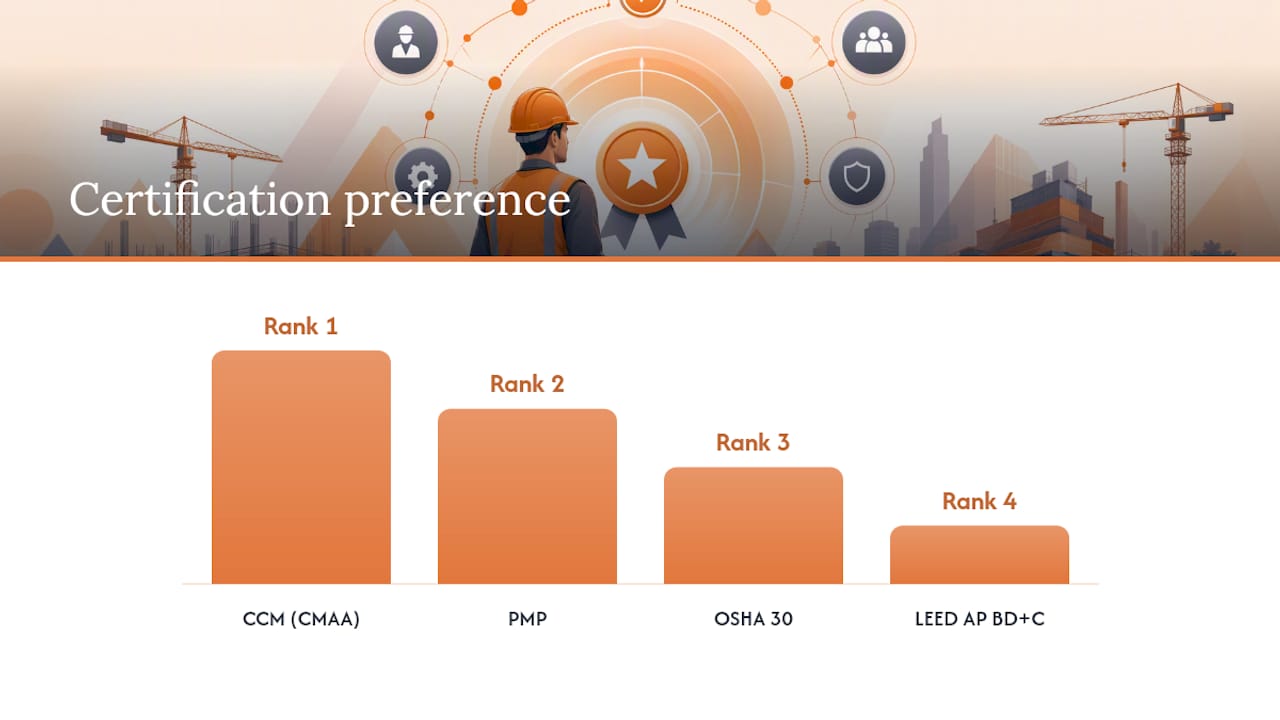
Certifications ranked by employer preference:
CCM (Certified Construction Manager, CMAA): The most construction-specific credential; preferred by owners and construction managers on complex commercial, institutional, and infrastructure projects
PMP (Project Management Institute): Broadly recognized across industries; valued by corporate real estate clients and firms with cross-sector project portfolios. PMI’s PMP is not construction-specific but signals rigorous process discipline
OSHA 30: Near-universal minimum requirement for site-based PM roles
LEED AP BD+C: Relevant for commercial, education, and government projects with sustainability mandates
Procore and Autodesk Build proficiency have become de facto screening filters at many mid-size and large GCs. Listing them on a resume without being able to demonstrate use in an interview is a red flag recruiters notice quickly.
What do construction project managers earn, and what is the job outlook?
Pay for CPMs varies significantly by sector, project complexity, geography, and credential level. The national median is a useful anchor, but the real market sits above it for credentialed, experienced managers on complex builds.
Market / Source | Annual Salary |
|---|---|
National median (BLS, May 2024) | $106,980 |
Senior and specialized roles | Above the national median |
Phoenix, AZ average base (Indeed, 413 reports) | Around national median |
Industry wage surveys point to rising pay for construction managers, a signal of heavy employer competition for credentialed PMs. Indeed’s Phoenix data reflects a Sun Belt market where data center and semiconductor fab construction has driven sustained demand.
What moves pay up:
Project size and complexity (a $200M healthcare build pays more than a $5M retail fit-out)
Sector: data centers, biotech/life sciences, and semiconductor fabrication facilities command the highest premiums
CCM or PMP credential combined with 10+ years of experience
Local labor market tightness, particularly in high-growth metros
Most openings will come from both growth and replacement demand as experienced PMs retire. For hiring managers, this means the candidate pool for senior roles will remain tight, and compensation benchmarks will continue to rise. For state-level projections, ProjectionsCentral compiles regional employment forecasts by occupation.
Candidates who hold a CCM or have managed projects above $50M routinely command offers at or above the national median.
What does career progression look like for a construction project manager?
The CPM title is a mid-career designation, not a ceiling. Most experienced PMs have at least two or three realistic advancement paths depending on whether they want to stay in operations, move to the owner side, or grow into executive roles.
Common advancement titles and tracks:
Senior Project Manager: Multi-project oversight, mentoring junior PMs, accountability for a project portfolio rather than a single job
Program Manager: Manages a series of related projects for a single client or program (common in healthcare, higher education, and government)
Director of Project Management / VP of Operations: Executive-level accountability for all project delivery across a division or company
Owner’s Representative / Owner-Side PM: Moves from the GC side to represent the building owner; often commands higher base pay with less travel
Construction Executive: P&L ownership for a business unit, typically requiring 15+ years and a track record on $100M+ projects
Specializations that raise market value:
Data center and mission-critical construction (electrical and mechanical complexity commands premium pay)
Biotech and pharmaceutical facilities (cleanroom protocols, validation requirements)
Heavy civil and infrastructure (bridges, highways, transit)
LEED/sustainable commercial construction for clients with ESG mandates
Exposure to large, complex projects accelerates progression more reliably than tenure alone. A PM who has managed a $100M project at year eight will outpace a PM with 15 years of $5M retail work in both compensation and title.
How Does the PM Role Fit With the Rest of the Project Team?
A project manager rarely works alone. On most commercial jobs, five roles split the work between strategy and field execution. Knowing where each one sits helps candidates plan their path and helps employers avoid asking one person to do two jobs.
Role | What they own | Usual next step |
|---|---|---|
Field Engineer | On-site data: testing, measurements, inspections, as-built conditions, and quantity tracking for the superintendent | Project Engineer |
Project Engineer | RFIs, submittals, spec enforcement, and the change-order, RFI, and submittal logs that protect the contractor's position | Assistant PM, then PM |
Superintendent | Daily site authority: labor, daily scheduling, trade conflicts, and real-time safety enforcement | Senior Superintendent or Construction Manager |
Construction Manager | On-site execution and quality control across the broader operation | Program Manager |
Project Manager | Contracts, budget, schedule governance, and the owner relationship | Senior PM, Program Manager, or VP |
What are the two ladders into project leadership?
The engineering track: Field Engineer to Project Engineer to Assistant Project Manager to Project Manager.
The field track: Laborer or Foreman to Superintendent to Construction Manager to Program Manager.
Both tracks meet at senior leadership, where the strongest executives carry field credibility and business judgment. Managers with real site time tend to make better scheduling, subcontractor, and quality calls than office-only managers, because they have seen how the work actually gets built.
Why the Project Engineer seat matters so much
The Project Engineer is often treated as a junior PM. It isn't. It is the technical and administrative backbone of the job, sometimes called the "lawyer of the job site." A PE who resolves design conflicts through RFIs before they reach the field keeps the PM focused on budget and the owner. Mastering RFIs and submittals is the most reliable path from PE to PM. Employers who want to grow PMs internally should put PEs on high-RFI-volume projects early, and should not fill the seat with the cheapest available candidate. A strong field engineer also doesn't automatically become a strong PE without building contract literacy and documentation discipline.
The same logic applies at the top. On larger or more complex projects, keep the PM and the construction manager or superintendent as separate people. When one person carries both the owner queue and the field queue, decisions slow down and oversight slips on both sides.
How should employers write a construction project manager job description?
A weak job description attracts the wrong candidates and wastes screening time. The most common mistake is listing generic duties without specifying project type, size, and software requirements. Here is a plug-and-play template and a pre-hire screening workflow.
Job description template:
Role summary: Seeking an experienced construction project manager to lead [project type, e.g., commercial ground-up or healthcare renovation] projects ranging from [$X to $Y] in value. Reports to [VP of Operations / Division Manager].
Responsibilities: Budget management and cost forecasting; schedule development and maintenance; subcontractor selection, scoping, and management; RFI/submittal processing; owner and architect communication; change-order negotiation; safety plan oversight; pay-application review and approval
Required qualifications: BS in Construction Management, Civil Engineering, or related field (or equivalent experience); 5+ years of PM experience on commercial projects; OSHA 30 certification; Procore or equivalent platform proficiency
Preferred qualifications: CCM or PMP credential; Primavera P6 experience; LEED AP; experience on projects above $20M
Compensation: Base salary range [$X–$Y], performance bonus, vehicle allowance, benefits
Reporting structure: Reports to [title]; supervises project engineers and field coordinators
Interview checklist (behavioral + technical + situational):
Walk me through a project where the budget was trending over. What did you do, and what was the outcome?
Describe your change-order process from identification to execution. What documentation do you require?
How do you build and maintain a CPM schedule? What software do you use, and how do you manage float?
Tell me about a time a subcontractor failed to perform. How did you handle it contractually and operationally?
How do you communicate bad news to an owner? Give me a specific example.
What is your process for reviewing and approving a pay application?
Describe a safety incident or near-miss you managed. What was your role and what changed afterward?
How do you prioritize when three critical path items are at risk simultaneously?
Screening red flags: Candidates who cannot produce a redacted pay application, a sample schedule with critical path notation, or a change-order log from a past project should be treated with caution. Vague answers about “overseeing” work without specific dollar values or trade counts are a consistent signal of limited accountability. For a deeper look at common hiring mistakes, see construction project manager hiring pitfalls to avoid.
Pre-hire screening workflow:
Resume screen: Confirm project types, sizes, and software match the role requirements
Phone screen (30 min): Verify compensation expectations, availability, and top two or three projects managed
Technical panel (60–90 min): Walk through a sample schedule, cost report, and change-order scenario with a senior PM or operations leader
Field visit or reference call: Contact a past superintendent or project owner directly; ask specifically about the candidate’s cost control and subcontractor management
Why is construction project management one of the most stressful roles in the industry?
The CPM role carries accountability without always having full authority. Budget overruns, schedule delays, subcontractor failures, and owner disputes land on the PM’s desk regardless of cause. That structural tension is the root of most burnout in the role.
Primary stress drivers:
Accountability pressure without commensurate authority over resources or decisions
Unrealistic schedules set during preconstruction that compress into the field phase
Resource shortages: labor, materials, and equipment availability that the PM cannot directly control
Constant context-switching between administrative tasks, field issues, and owner demands
Fear of reporting problems up the chain, which delays resolution and compounds risk
A peer-reviewed study in the Journal of Construction Engineering and Management found that organizational justice dimensions, specifically distributive (fair outcomes), procedural (fair processes), and interactional (respectful treatment) justice, directly influence burnout pathways among construction project managers. Procedural and interactional justice had the strongest buffering effect on stress. In plain terms: PMs who believe decisions are made fairly and that they are treated with respect are significantly less likely to burn out, even under heavy workloads.
Research on workplace stress disclosure also shows that construction managers often hesitate to report stress due to fear of professional repercussions, which prevents organizations from addressing the problem before it becomes a retention crisis.
Practical mitigation strategies:
Build schedule buffers into preconstruction rather than absorbing compression in the field
Establish a clear delegation framework so project engineers handle RFI and submittal tracking without PM bottlenecks
Create a formal change-order log that is reviewed weekly, reducing end-of-project disputes
Implement anonymous stress reporting or regular one-on-one check-ins as a management practice
Benchmark workload against project dollar volume: one PM managing more than $20–25M simultaneously without support staff is a structural risk
Pro Tip: Procedural transparency is the single most cost-effective burnout prevention tool available to a construction firm. When PMs understand how decisions are made and have a documented process for escalating issues, perceived injustice drops and engagement rises. A weekly 15-minute risk review with the operations director costs nothing and signals that the organization is paying attention.
How specialist recruiters source and vet construction project managers
Finding a qualified CPM through a general job board is possible. Finding one who can manage a $30M commercial build, navigate a difficult owner, and keep a subcontractor team aligned is a different task entirely. Specialist AEC recruiters approach it differently.
The sourcing and vetting process used by specialist firms:
Sourcing: Active outreach to passive candidates through industry networks, trade associations, and referral pipelines, not just job board applicants
Screening: Verification of project types, dollar values, and software proficiency before the first client introduction
Work-sample vetting: Requesting redacted cost reports, change-order logs, and schedule excerpts to confirm hands-on accountability
Reference checks: Direct calls to past superintendents and project owners, not just HR contacts, to validate field collaboration and cost control
Offer negotiation: Market-rate benchmarking using current wage data to position offers competitively without overpaying
Client benefits of working with a specialist recruiter:
Faster time-to-hire: pre-screened candidates reduce the interview cycle from weeks to days
Higher placement quality: work-sample vetting filters out candidates who managed in title only
Prorated fee structure: you pay for performance, not for activity
Access to passive candidates who are not actively applying but are open to the right opportunity
Vetting checklist items recruiters use:
Redacted pay application from a project above $5M
Sample CPM schedule showing critical path and float management
Change-order log with dollar values and resolution outcomes
Reference from a past superintendent confirming field collaboration quality
Evidence of subcontractor selection and scope negotiation experience
For a detailed look at what the 2026 CPM career guide covers on role expectations and candidate pathways, it is worth reviewing alongside your job description before you post.
Pro Tip: Ask every CPM candidate: “Show me a change order you wrote that the owner initially rejected. How did you document it, and how did it resolve?” The answer reveals contract knowledge, communication skill, and composure under pressure simultaneously. Candidates who cannot produce a specific example with a dollar value and a resolution are telling you something important.
What hiring managers and candidates often get wrong
The most consistent pattern in CPM hiring is the mismatch between what a job description says and what the role actually demands. A posting that lists “5 years of experience” without specifying project type, dollar volume, or software requirements will attract a wide range of candidates, most of whom are not a fit.
For candidates, the equivalent mistake is presenting a resume that lists duties instead of outcomes. “Managed subcontractors” is not a qualification.
Three hiring shortcuts that consistently produce better outcomes: require a work sample before the technical panel, call the superintendent reference before the owner reference (superintendents give more candid assessments), and price the role at or above the market median if you need someone in 60 days or less. The market for credentialed PMs is tight, and below-market offers extend your search by months.
For candidates: document every project with dollar values, trade counts, and schedule outcomes before you apply. Hiring managers at general contractors respond to specifics, and diverse candidates with non-traditional backgrounds should know that field-to-PM routes are well-regarded at firms that understand what hands-on experience actually produces.
Hire vetted construction project managers faster with R. Construction Solutions
Filling a CPM role with the wrong candidate costs far more than a recruiter’s fee. NetworkHUB brings 30+ years of AEC industry experience to every search, with a pre-vetted candidate pipeline built specifically for construction management roles, not adapted from a general staffing database.

The prorated 90-day payment model means you pay for a successful placement, not for effort. Commission rates run lower than the general staffing market, and every candidate presented has been screened against the work-sample vetting checklist described in this guide: cost reports, change-order documentation, and superintendent references. Whether you need a project manager for a ground-up commercial build, a healthcare renovation, or a data center program, NetworkHUB matches the candidate’s project history to your specific scope. Visit the AEC recruiting services page to start a search or discuss your current opening.
Sources
The following authoritative sources were used for wage data, task definitions, credential guidance, and burnout research throughout this article.
FAQ
What does a construction project manager actually do?
A CPM manages a project’s budget, schedule, contracts, subcontractors, and owner communication from preconstruction through closeout. Per O*NET, core tasks include planning, scheduling, budgeting, coordinating, and supervising construction activities.
Is construction project management a stressful job?
Yes, consistently. The role carries full accountability for budget and schedule outcomes with limited direct control over labor, materials, and design decisions. A peer-reviewed study in the Journal of Construction Engineering and Management found that organizational justice dimensions, particularly fair processes and respectful treatment, are the strongest buffers against burnout.
How much does a construction project manager make in Arizona?
Indeed reports an average base salary of $111,591 per year for construction project managers in Phoenix, based on 413 salary reports. The national median is $106,980 per the BLS, so Phoenix tracks slightly above the national figure.
What is the highest-paid position in construction?
Construction executives and program managers overseeing large portfolios typically earn the most. Senior CPMs specializing in data centers, biotech facilities, or semiconductor fabrication command the highest premiums at the project management level, often well above the national median.
What certifications do employers require for a construction project manager?
OSHA 30 is the near-universal minimum. The CCM (Certified Construction Manager, CMAA) is the most construction-specific professional credential and is preferred on complex commercial and institutional projects. The PMP (PMI) is broadly recognized and valued by corporate real estate and cross-sector clients.